The Last Camp of Hi Jolly: Why There is a Camel Pyramid in Quartzsite
If you drive Interstate 10 between Phoenix and Los Angeles, you eventually hit Quartzsite. For most travelers, it’s a blur of gas stations, RV parks, and gem shows. However, if you pull off the highway and head toward the center of town, you will find one of the strangest and most historically significant gravesites in the American West.
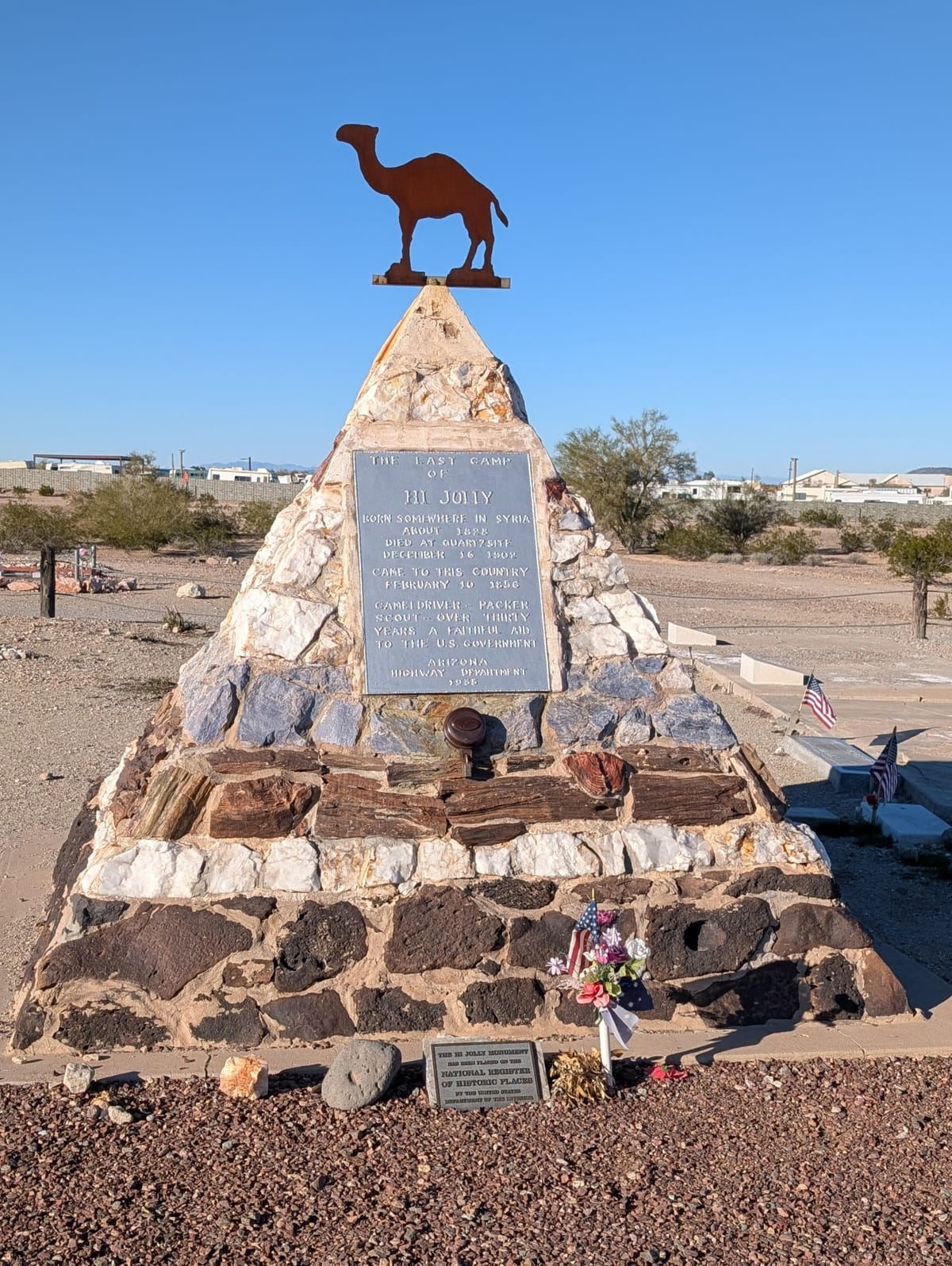
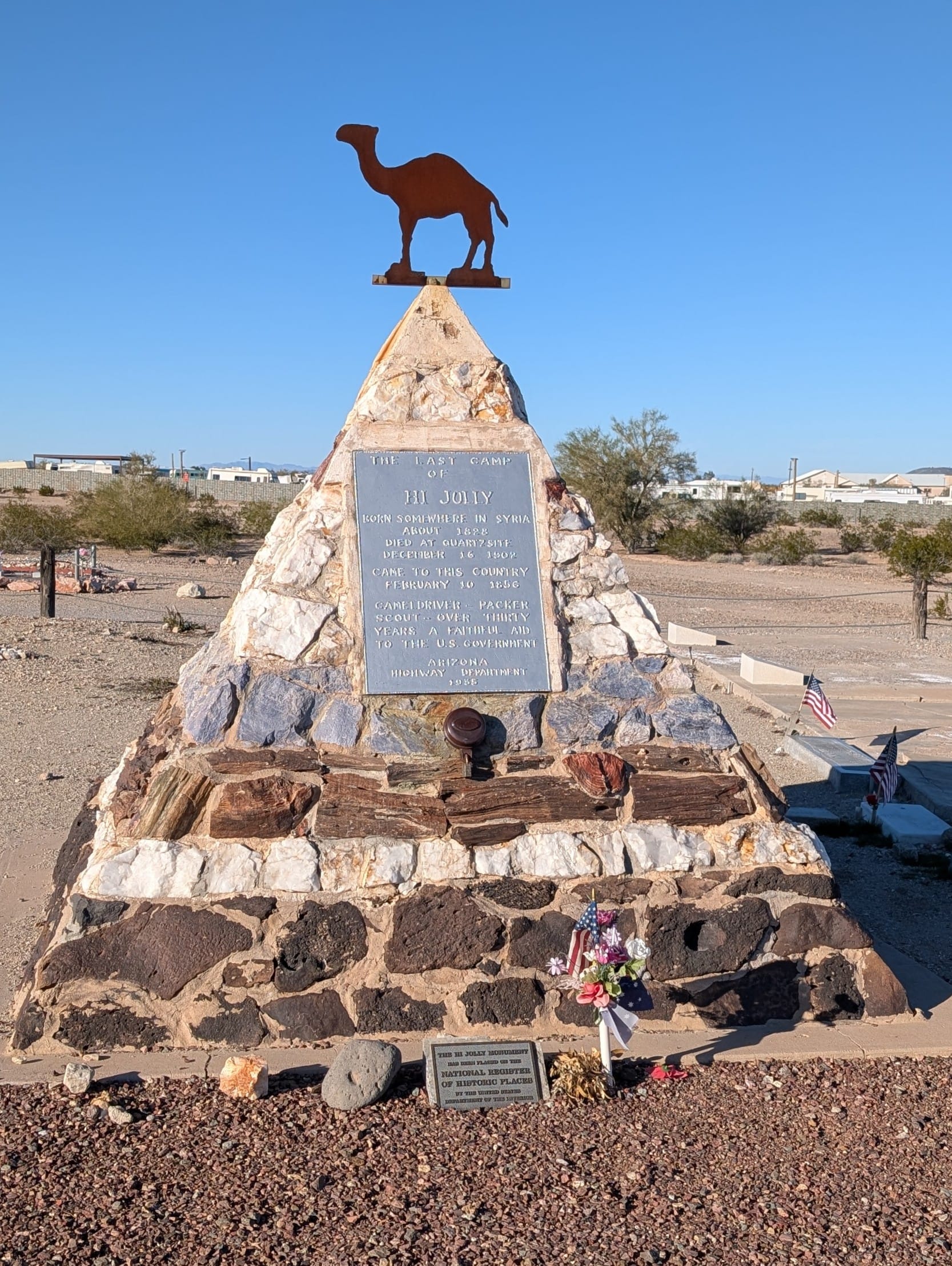
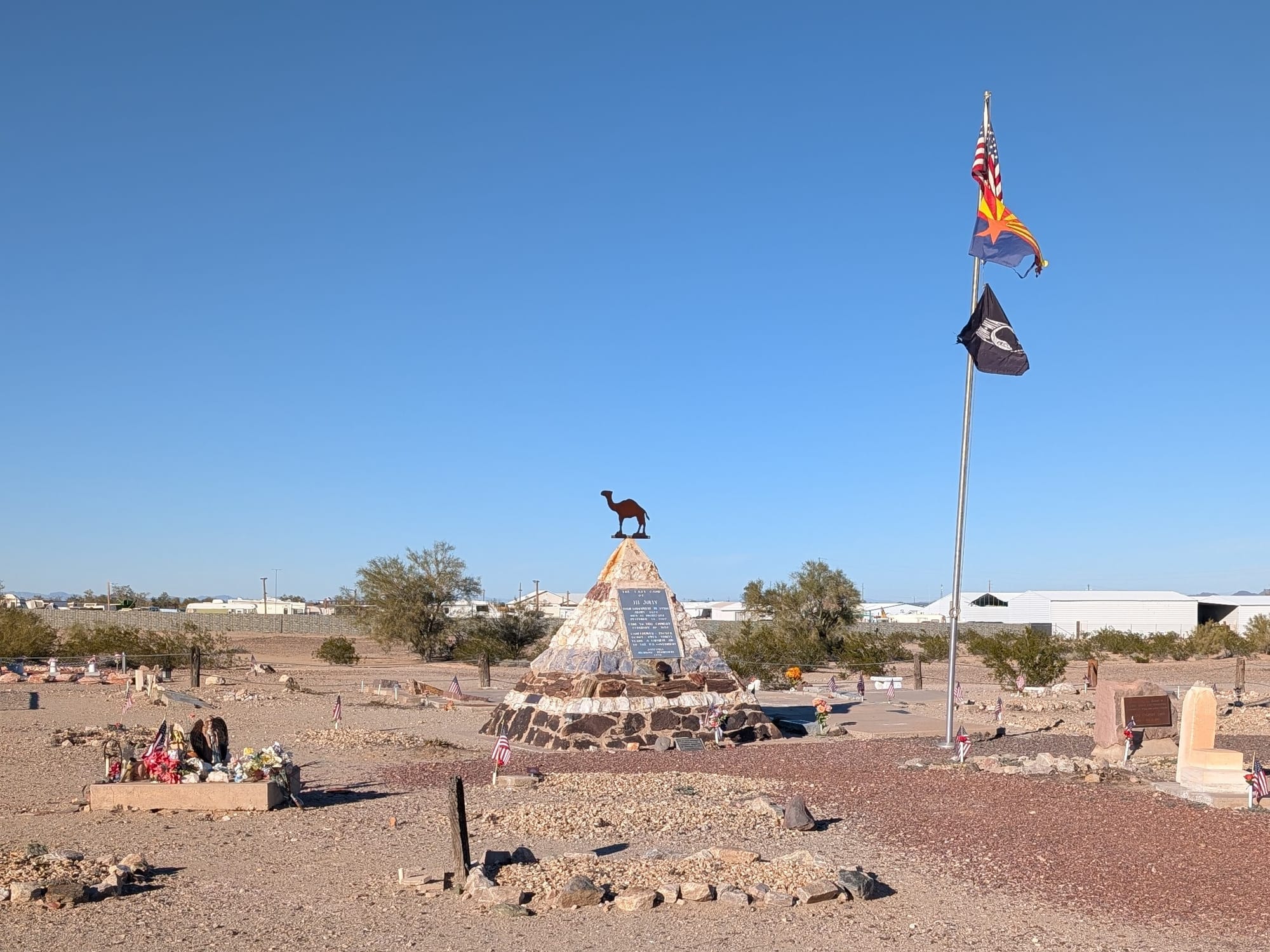
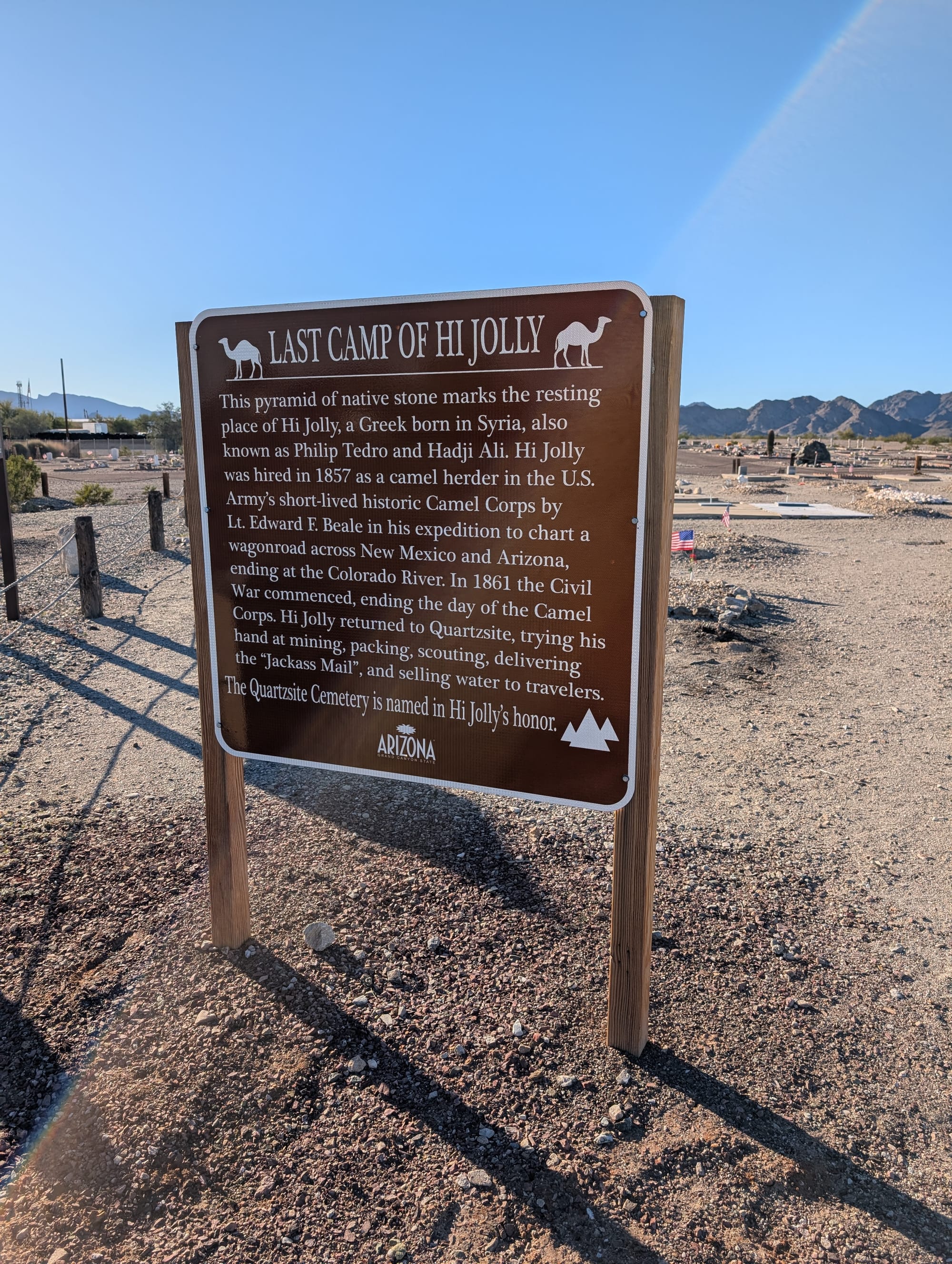
Standing inside the local cemetery is a pyramid built from local stone, topped by a metal camel. It marks the final resting place of Hadji Ali, a man known to history as "Hi Jolly," and it stands as a monument to one of the U.S. Army’s most unique experiments: The U.S. Camel Corps.
Jefferson Davis and the Camel Experiment
The story begins in the 1850s, a time when the United States was expanding westward. The Army faced a difficult logistical problem: crossing the vast, arid deserts of the Southwest was brutal on horses and mules. They needed water frequently and struggled in the heat.
In 1855, Secretary of War Jefferson Davis (who would later become the President of the Confederacy) convinced Congress to appropriate $30,000 for a radical experiment. He theorized if camels did so well in the Middle East and North Africa, they would be perfect for the American Southwest.
The government acquired over 70 camels and shipped them to Indianola, Texas. The Army knew that American soldiers didn't know how to handle these animals and to ensure success, they hired several experienced handlers from the Ottoman Empire to accompany the herd.
Enter Hadji Ali
Among the handlers who arrived in 1856 was a man born Philip Tedro, a Greek-Syrian convert to Islam who went by the name Hadji Ali. He was a skilled breeder and trainer, but his name proved too difficult for the American soldiers to pronounce. They quickly corrupted "Hadji Ali" into the friendly, phonetically similar nickname: "Hi Jolly."
By all accounts, the experiment was a technical success. The camels proved superior to mules in almost every way relevant to the desert. They could carry heavier loads (up to 1,000 pounds), travel up to 30 miles a day, and go for days without water. Hi Jolly and the Camel Corps surveyed routes from Texas to California, including the famous Beale Wagon Road (which roughly mirrors parts of modern-day Route 66 and I-40).
Why the Experiment Failed
Despite their performance, the Camel Corps was doomed. The Civil War broke out in 1861, shifting the government's focus and funding entirely to the east.
Furthermore, while the camels were efficient, they were unpopular. They smelled terrible, had notoriously bad tempers, and perhaps most importantly, they terrified the horses and mules. The Army eventually abandoned the project. The camels were sold to zoos, circuses, and mining operations, while others were simply turned loose to fend for themselves. These feral survivors roamed the desert for decades, likely giving rise to the famous Arizona cryptid, the Red Ghost. Sightings of the animals continued well into the 20th century, with the last reported sighting occurring as late as the 1940s.
A Life in the Desert
While many of the foreign handlers returned home after the experiment ended, Hi Jolly stayed. He had grown fond of the American Southwest. He eventually became a naturalized U.S. citizen in 1880.
Over the next few decades, he lived a true frontiersman's life. He worked as a prospector, a freight hauler, and a scout for the U.S. Army, reportedly working under General Crook during the campaign against Geronimo.
In his later years, he settled in Quartzsite (then known as Tyson’s Wells). He died on December 16, 1902, leaving behind a legacy that the locals refused to forget.
The Monument
In 1935, the Arizona Highway Department (now ADOT) constructed the monument that stands today to honor Hi Jolly's contribution to the state's history.
The structure is a pyramid made of local multi-colored quartz and petrified wood. Sitting atop the pyramid is a metal silhouette of a camel. A bronze plaque on the side reads:
THE LAST CAMP OF HI JOLLY Born somewhere in Syria about 1828. Died at Quartzsite December 16, 1902. Came to this country February 10, 1856. Camel driver — Packer — Scout. Over thirty years a faithful aid to the U.S. Government in Arizona.
The monument is also technically the resting place for the ashes of "Topsy," the last surviving camel from the original government herd, which died in Los Angeles in 1934 and was sent to Quartzsite to be with the famous handler.
How to Visit
- Location: The cemetery is located near the intersection of W. Main Street and U.S. Highway 95.
- Cost: Free.
- Time: 15–20 minutes.
- Parking: There is a large dirt parking area directly in front of the cemetery, easily accessible for cars and RVs.
It is a quick stop, but standing there, looking at a pyramid in the middle of the desert, offers a tangible connection to one of the most fascinating "what ifs" in Arizona history.
Subscribe to Roam Arizona
Sign up to get new Arizona stories, hidden gems, and updates delivered to your inbox.
You’re officially on the trail.
Peek at your inbox (or the spam gulch) for your first map.